Manufacturing & Engineering · Melbourne
Forklift Hire for Manufacturing & Engineering
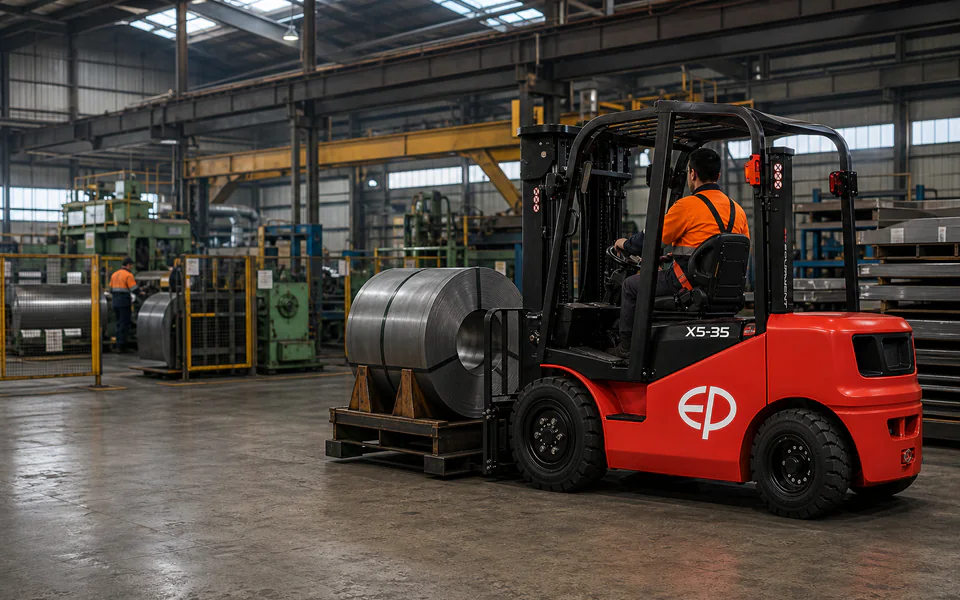
Manufacturing loads are heavier, longer and less forgiving than warehouse pallets. The forklift that moves them needs genuine capacity headroom — and a supplier who checks the load chart before quoting, not after something bends.
Why manufacturing breaks the “2.5 tonne default”
Most hire enquiries start with “we need a 2.5 tonne forklift” — and in manufacturing, that assumption fails more often than anywhere else. Three reasons:
- Dense loads. A pallet of steel fittings, castings or moulds hits 2,500 kg in half the footprint of a beverage pallet. If your heaviest regular load sits near the machine’s limit, you’re working the truck at its edge every day — a wear problem and a safety problem.
- Long product. Steel lengths, extrusions, timber packs and pipe move the load centre well past the 500 mm the rating assumes. Capacity falls fast — how load centres really work. A “2.5 t” machine carrying 3 m stock may be a 1.8 t machine in practice.
- Mixed ground. Factory floor to yard and back, all shift. That asks for ground clearance (the EFX5 platform’s 150 mm), solid tyres, and gradeability for ramps — brochure numbers we publish on every model page.
Melbourne’s south-east — Dandenong South, Braeside, Hallam — holds the densest concentration of this work in Victoria, and it’s also where our supplying dealer network keeps parts and technicians. Manufacturing downtime is measured in stopped lines; service radius matters.
The machines we put into factories
- EP EFX5-351 — the honest answer for steel, stone and heavy product: genuine 3,500 kg rating, 24 kW lift motor, 150 mm clearance. Costs only a small step over the 2.5 t and removes the daily at-the-limit problem.
- EP EFX5-251 — the general-duties machine for component and light-fabrication work, with the same platform, parts and charger as its big brother — one spares story across a mixed fleet.
- EP EFL181 — for the finished-goods corner or a satellite unit without three-phase power: it charges from a standard 15A outlet.
Compliance notes manufacturers ask about
Every machine arrives with its load chart matched to the fitted attachments, operator manual, daily pre-start checklist and logged service records — the paper trail your safety system expects (daily checklist guide). Operators need an LF-class high-risk work licence in Victoria (licence guide); machine-to-task matching is documented in our fit assessment.
Common questions
Manufacturing & Engineering forklift hire — FAQs
Can an electric forklift handle 3-tonne steel and full shifts in a factory?
Yes — the EP EFX5-351 is rated 3.5 t with a 24 kW lift motor (S3 15% duty) and a 22.4 kWh pack that covers a full production shift. Electric drive also removes exhaust from indoor production areas, which LPG cannot.
What happens when a hired forklift breaks down mid-production?
Maintenance and repair are included in the hire agreement and serviced through the dealer network in Dandenong South. Faults are logged, response is prioritised, and persistent issues fall under the agreement's remedy terms — you are not carrying repair risk on a machine you don't own.
Is single-phase power enough to charge a factory forklift?
For one model, yes: the EP EFL181 (1.8 t) has a built-in 50A charger that runs from a single-phase 15A outlet. Every larger machine in the fleet needs a three-phase outlet for its 60A or 100A charger.
Running manufacturing & engineering in Melbourne?
Tell us your loads, site and hours — we'll spec the right machine and quote it the same business day.